Play Hymn:" How Can I Keep From Singing
| How Can I Keep from Singing? | |
|---|---|
| by Robert Lowry | |
 Robert Lowry | |
| Genre | Hymn |
| Based on | Psalms 145 |
| Meter | 8.seven.eight.vii with refrain |
"How Tin can I Keep From Singing?" (also known by its incipit "My Life Flows On in Endless Song") is an American folksong originally composed as a Christian hymn by American Baptist minister Robert Lowry. The song is frequently, though erroneously, cited every bit a traditional Quaker or Shaker hymn. The original composition has at present entered into the public domain, and appears in several hymnals and vocal collections, both in its original form and with a revised text that omits about of the explicitly Christian content and adds a verse near solidarity in the face of oppression. Though information technology was not originally a Quaker hymn, Quakers adopted it every bit their own in the twentieth century and utilize information technology widely today.
[edit]
The start known publication of the words was on August 27, 1868, in The New York Observer. Titled "Always Rejoicing", and attributed to "Pauline T.",[i] [ii] the text reads:
My life flows on in countless vocal;
Above earth's lamentation,
I hear the sweet , tho' far-off hymn
That hails a new cosmos;
Thro' all the tumult and the strife
I hear the music ringing;
It finds an echo in my soul—
How tin can I keep from singing?
What tho' my joys and comforts die?
The Lord my Saviour liveth;
What tho' the darkness gather round?
Songs in the dark he giveth.
No storm tin can milkshake my inmost calm
While to that refuge clinging;
Since Christ is Lord of sky and earth,
How can I keep from singing?
I lift my eyes; the deject grows sparse;
I see the blue to a higher place it;
And 24-hour interval by day this pathway smooths,
Since first I learned to beloved it,
The peace of Christ makes fresh my heart,
A fountain ever springing;
All things are mine since I am his—
How can I go along from singing?
The word "real" is as well used hither, perhaps following Pete Seeger.
These are the words as published by Robert Lowry in the 1869 song book, Bright Jewels for the Sunday School.[3] Here Lowry claims credit for the music, an iambic 8.7.viii.7.D melody,[4] just gives no indication equally to who wrote the words. These words were also published in a British periodical in 1869, The Christian Pioneer,[5] just no author is indicated. Lewis Hartsough, citing Bright Jewels as source of the lyrics and crediting Lowry for the melody, included "How Can I Go along from Singing?" in the 1872 edition of the Revivalist.[6] Ira D. Sankey published his own setting of the words in Gospel Hymns, No. 3 (1878), writing that the words were anonymous.[7] In 1888, Henry S. Burrage listed this hymn as one of those for which Lowry had written the music, but not the lyrics.[8]
Doris Plenn learned the original hymn from her grandmother, who reportedly believed that information technology dated from the early days of the Quaker movement. Plenn contributed the post-obit verse around 1950, and it was taken upwardly by Pete Seeger and other folk revivalists:[ii]
When tyrants tremble, sick with fear,
And hear their death-knell ringing,
When friends rejoice both far and near,
How tin can I keep from singing?
In prison house cell and dungeon vile,
Our thoughts to them become winging;
When friends by shame are undefiled,
How can I proceed from singing?
History [edit]

Version first published in Bradbury's Bright Jewels for the Lord's day School (1869)
During the 20th century, this hymn was not widely used in congregational worship. Diehl'south index to a large number of hymnals from 1900 to 1966 indicates that merely one hymnal included it: the 1941 edition of The Church Hymnal of the Seventh-day Adventist Church, titled "My Life Flows On" (hymn no. 265).[9] [10] It was as well published in the earlier 1908 Seventh-day Adventist hymnal, Christ in Song, under the title "How Tin can I Keep From Singing?" (hymn no. 331).[eleven] The United Methodist Church published it in its 2000 hymnal supplement, The Faith We Sing (hymn no. 2212), giving credit for the lyrics as well as the tune to Robert Lowry.[12] The Religion Nosotros Sing version changes some of the lyrics and punctuation from the 1868 version. The Unitarian Universalist hymnal, printed in 1993 and post-obit, credits the words as an "Early on Quaker song" and the music as an "American gospel melody".[13]
Pete Seeger learned a version of this vocal from Doris Plenn, a family friend, who had information technology from her North Carolina family unit. His version made this song adequately well known in the folk revival of the 1960s. Seeger's version omits or modifies much of the Christian wording of the original, and adds Plenn's verse above. The reference in the added poetry intended by Seeger and by Plenn—both active in left-wing causes—is to 'witch hunts' of the House Un-American Activities Commission. (Seeger himself was sentenced to a yr in jail in 1955 as a result of his testimony before the committee, which he did not serve due to a technicality.)[ vague ] [ citation needed ] Near folk singers have followed Seeger'southward version.
In his radio singing debut, thespian Martin Sheen performed this song (using the Plenn–Seeger lyrics) on A Prairie Home Companion in September 2007.[14]
Use past Quakers [edit]
The song has ofttimes been attributed to "early" Quakers, merely Quakers did not permit congregational singing in worship until later on the American Civil War (and many yet do not take music regularly). Just learning it in social activist circles of the fifties and hearing Seeger's (erroneous) attribution endeared the song to many gimmicky Quakers, who have adopted it every bit a sort of anthem. It was published in the Quaker songbook Songs of the Spirit,[fifteen] and the original words, with Plenn's verse, were included in the much more ambitious Quaker hymnal project, Worship in Song: A Friends Hymnal [16] in 1996.
Enya version [edit]
| "How Tin can I Keep From Singing?" | ||||
|---|---|---|---|---|
 | ||||
| Unmarried past Enya | ||||
| from the album Shepherd Moons | ||||
| B-side |
| |||
| Released | 1991 | |||
| Recorded | 1990 | |||
| Genre | New-age | |||
| Length | 4:24 | |||
| Label | WEA | |||
| Songwriter(s) | Robert Wadsworth Lowry | |||
| Producer(s) | Nicky Ryan | |||
| Enya singles chronology | ||||
| ||||
| Music video | ||||
| "How Can I Keep From Singing?" on YouTube | ||||
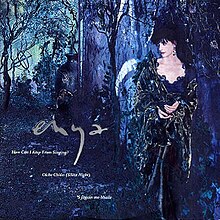
The song received new prominence in 1991 when Irish musician Enya released a recording of the hymn on her album Shepherd Moons. Enya's version follows Pete Seeger's replacement of some more overtly Christian lines, for instance: "What tho' my joys and comforts die? The Lord my Saviour liveth" became "What tho' the tempest 'round me roars, I hear the truth it liveth." The song was released as a single in November of the same yr, with "Oíche Chiún" and "'Southward Fágaim Mo Bhaile" appearing every bit additional songs.[ citation needed ] It reached the top 50 in Commonwealth of australia, Ireland, Sweden, and the United Kingdom.
Lawsuit [edit]
Enya and her record company were sued for copyright infringement by Sanga Music, Inc. for recording the song because she had mistakenly credited this rail as a "traditional Shaker hymn", thus assumed it as public domain. Pete Seeger had helped make the song fairly well known in the 1950s past publishing it with Doris Plenn's additional 3rd verse in his folk music magazine Sing Out! (Vol. 7, No 1. 1957), recording information technology, and mistakenly credited it as a "traditional Quaker hymn" without copyrighting Plenn'southward verse, thus presenting the entire vocal every bit "public domain". It was again published by Sanga Music, Inc. in 1964. Seeger had presented the new poesy as being public domain and Plenn had only wanted the song to exist preserved rather than seeking to make a turn a profit from it, so the court decided that Enya could use the verse without paying royalties.[17]
Music video [edit]
The video clip features Enya singing in a church building in the Gaoth Dobhair countryside while besides including archive footage of political figures such equally Nelson Mandela and Boris Yeltsin, among others, and references to the Gulf War and famine. The line nigh tyrants trembling shows Gennady Yanayev, leader of the 1991 August Insurrection, in a printing conference with visibly trembling hands—obviously toward the cease when the coup was unraveling.
Charts [edit]
References [edit]
- ^ "Archived re-create". Archived from the original on October 11, 2008. Retrieved June 25, 2009.
{{cite web}}: CS1 maint: archived copy as title (link) - ^ a b song history - How Tin I Keep From Singing Archived March 6, 2012, at the Wayback Machine. mudcat.org. Retrieved on November 23, 2011.
- ^ Robert Lowry, ed. Bright Jewels for the Sunday School. New York: Biglow and Master, 1869, hymn number 16.
- ^ Hymn 143, "How Can I Go on from Singing?" in Celebrating the Eucharist: Classic Edition, April 17, 2022 – August thirteen, 2016, Collegeville, MN: Liturgical Printing, p. 404, ISBN 978-0-81462-728-0 .
- ^ The Christian Pioneer, a monthly mag. Vol 23, page 39, London: Simpkin, Marshall & Co., 1866.
- ^ Hillman, Joseph; Hartsough, Lewis, eds. (1872). The revivalist: A collection of option revival hymns and tunes. Troy, New York. p. 305. , No. 586. The 1872 edition had 336 pages including revised and enlarged indexes merely was otherwise like in advent to the 1868 and 1869 editions.
- ^ Ira D. Sankey, Gospel hymns no. three, New York: Biglow & Primary, 1878, hymn no. 66
- ^ Burrage, Henry South. Baptist Hymn Writers and Their Hymns. Portland, Maine: Chocolate-brown, Thurston & Co., 1888, p. 433.
- ^ Takoma Park MD: Review and Herald Publishing Assn
- ^ Diehl, Katharine Smith (1996). Hymns and Tunes—An Index. New York: Scarecrow Press.
- ^ Washington DC: Review and Herald Publishing Clan. Facsimile reproduction.
- ^ HIckman, Hoyt L., ed. The Faith We Sing. Nashville, TN: Abingdon Printing, 2000, hymn no. 2212.
- ^ Singing the Living Tradition Boston, MA: The Unitarian Universalist Association, 1993, hymn no. 108.
- ^ "A Prairie Home Companion for September 29, 2007". American Public Media. Archived from the original on July 4, 2008. Retrieved December 17, 2012.
- ^ Friends General Conference Religious Education Committee (1978). Songs of the Spirit. Philadelphia: Friends Full general Conference.
- ^ Friends General Briefing (1996). Worship in Vocal: A Friends Hymnal. Philadelphia: Friends Full general Briefing.
- ^ Fishman, Stephen. "Copyright and the Public Domain" (PDF). www.lawcatalog.com. ALM. p. 6-6. Archived from the original (PDF) on April 4, 2016. Retrieved January 12, 2022.
- ^ "Enya – How Can I Keep from Singing?". ARIA Pinnacle 50 Singles. Retrieved September iii, 2020.
- ^ "Enya – How Tin I Keep from Singing?" (in Dutch). Ultratop 50. Retrieved September 3, 2020.
- ^ "Eurochart Hot 100 Singles" (PDF). Music & Media. Vol. ix, no. 2. January 11, 1992. p. 19. Retrieved September 3, 2020.
- ^ "The Irish Charts – Search Results – How Can I Go along from Singing". Irish Singles Nautical chart. Retrieved September 3, 2020.
- ^ "Enya – How Can I Keep from Singing?". Singles Top 100. Retrieved September 3, 2020.
- ^ "Enya: Artist Chart History". Official Charts Visitor. Retrieved September iii, 2020.
External links [edit]
- Original words with MIDI version of tune
- Seeger's lyrics
- How Tin I Keep From Singing - Is Information technology A Shaker Hymn?
Source: https://en.wikipedia.org/wiki/How_Can_I_Keep_from_Singing%3F
0 Response to "Play Hymn:" How Can I Keep From Singing"
Post a Comment