What Are the 4 Qualities of Love in Art of Loving
In his book "The Art of Loving" (1956) the psychoanalyst and philosopher Erich Fromm (1900-1980) discusses how beloved is often wrongly perceived as the passive "falling in dear." For Fromm, beloved is mainly a conclusion to dearest, to become a loving person. Through test of the concepts of father's beloved, mother's dear, God's beloved and erotic dear, Fromm argues that we need to change the way we run across love in gild to reach happier and more fulfilling relationships with others.
This article is function of The Ultimate Guide to the Philosophy of Erich Fromm.
Is beloved an art?
Erich Fromm found his biggest popular success with a book near love. In "The Art of Loving," he makes the example that honey is often misunderstood every bit this romantic notion, often seen in movies, of people "falling in love," of love being something that happens to us without us being able to resist or control the experience. Rather, Fromm says, love is an fine art. Similar any other art, it is something that we have to larn to do: we accept to learn and practise beloved just like we take to acquire and practice drawing or playing the piano.

Erich Fromm's "The Art of Loving" has been a classic in the philosophy and psychology of love since it was first published in 1956. It'south a highly readable, provocative and insightful book that might simply change the way you look at love.
Amazon chapter link. If yous buy through this link, Daily Philosophy will go a small commission at no cost to y'all. Thanks!
You can hear the echoes of Aristotle in this. For Aristotle, our whole life is an "fine art," in the sense that nosotros constantly take to practice and refine our virtues and our phronesis in club to reach success and happiness.
Love and responsibility
And so just similar Aristotle would say that happiness is not just something that "happens," Fromm would maintain that the same is truthful of beloved. If we meet love as something that randomly happens to u.s., nosotros lose the feeling of being responsible for our loves. We could then fall "out of love" every bit easily equally nosotros "barbarous in love".
For Fromm, this is a total misunderstanding of what beloved is about, in the aforementioned style every bit saying that happiness is nix but the enjoyment of pleasures is a misunderstanding of what happiness is really about.
For Fromm, love is a particular fashion of relating to others, and my ways of relating to others are in my control, at to the lowest degree potentially. In our (modern, Western) culture, Fromm says, we ofttimes remember that love is outside of our command, and our languages seem to support this view. Nosotros talk of the arrows of Cupid, or dear hitting u.s.a. like…
Here I googled "beloved hit me similar" and this is what Google gave dorsum as suggestions: like a railroad train, like a freight train, similar a ten-pound hammer, similar a hurricane. Fierce metaphors: the lover is powerless, a victim, striking by forces far too powerful to fifty-fifty contemplate resisting.

Recommended for y'all:
How to Live an Aristotelian Life
Aristotle'south theory of happiness rests on 3 concepts: (1) the virtues, which are good properties of one's grapheme that do good oneself and others; (two) phronesis, which is the ability to use the virtues to the right amount in any particular situation; and (3) eudaimonia, which is a life that is happy, successful and morally good, all at the aforementioned time. This calendar month, we hash out how to really go about living a life similar that.
But this view also has an opposite side: when our beloved does not feel like a freight railroad train hitting us, is it therefore less of a love? Do we need to have loves that are like hurricanes and ten-pound hammers, and are we wasting our time with the wrong person if beloved doesn't hit united states like a truck?
But this view as well has an opposite side: when our dear does not feel like a freight train hitting u.s., is it therefore less of a dear?
Fromm cautions confronting both views. Giving up the responsibility that nosotros have for the success of our relationships to others is not a practiced idea, he says. Grown-up, psychologically well-adjusted persons are those who are in control of their relationships, who sympathize that human relations need effort and piece of work and that they don't "just happen".
In fact, information technology'southward a kittenish, infantile expectation to be given unconditional love for no proficient reason and without one'southward own contribution. It is what happens to us when nosotros are minor and when we feel the love of our mothers: a love that is indeed unconditional and accepting, and for which we don't need to do anything to deserve information technology.
Recommended for you:
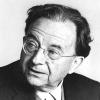
Erich Fromm (1900-1980)
Erich Fromm (1900-1980) was a German social psychologist and philosopher who had enormous popular success from the 1950s all the way to the end of his life in 1980. We discuss his work and his relation to Marxism and Freud.
Simply for Fromm, the psychologist, it is obvious that staying in that infantile stage regarding our emotions is wrong. As we grow up nosotros realise that we do have to take responsibility for our relations to others – and that we have to earn our friendships and loves with our own behaviour towards those we befriend and love.
Father'south, mother's and God'due south love
According to Fromm, this is a process that begins with the father, whose beloved is not unconditional (like that of the mother) but dependent on good manners, good grades in schoolhouse, helpfulness, intelligence and many other contingent backdrop of our character and behaviour. It is besides, Fromm thinks, no accident that our Christian God is thought of as God the Father, rather than God the Mother.
As feminists take often pointed out, the Christian God is asexual and nosotros should therefore exist as justified in seeing Him/Her as a mother equally much as a father. Simply, Fromm says, there is indeed something specifically "fatherly" about God and that is the conditional character of God'southward love. Similar with whatever begetter's love, nosotros have to earn God'southward love with our behaviour: by abnegation from sin, by obeying His commands, by having the correct thoughts and motivations, by existence good members of His church.
Every bit feminists accept often pointed out, the Christian God is asexual and we should therefore be every bit justified in seeing Him/Her equally a mother as much equally a father.
The Bible contains aplenty evidence for what we can expect to happen if we don't prove to exist skillful children to God the begetter: from beingness turned into a pillar of salt, or being drowned in a globe-wide flood, to being burned alive as fire rains from the heavens, destroying whole cities. The wrathful God, the God of vengeance: this is a father figure, co-ordinate to Fromm, and the reason that we perceive God every bit male. The motherly character of God, the unconditionally loving and forgiving, is more often associated with the Virgin Mary (The Art of Loving, Harper Perennial Classics Edition, 2000, pp.60-63)
Honey as witting endeavor
Fromm writes:
[Erotic beloved] is frequently confused with the explosive experience of "falling" in love, the sudden collapse of the barriers which existed until that moment between two strangers. But, as was pointed out before, this experience of sudden intimacy is by its very nature short-lived. Subsequently the stranger has become an intimately known person there are no more than barriers to be overcome, there is no more sudden closeness to be achieved. The "loved" person becomes too known as oneself. (p.49)
But for Fromm, the will is crucial for truthful love:
To beloved somebody is non just a strong feeling – it is a determination, information technology is a judgement, information technology is a promise. If love were but a feeling, there would be no basis for the promise to love each other forever. A feeling comes and it may get (…) (p.52)
Peradventure surprisingly, therefore, Fromm sees more potential for truthful love in arranged marriages than in relationships that are based on the spontaneous feeling of "falling" in love. In contrast to "romantic" love, an arranged relationship already begins without the assumption that at that place needs to be something that hits ane like a freight train – and therefore, the absence of such a feeling is not perceived every bit a arrears. Rather, the partners in an arranged relationship are fully conscious of the need to actively begin loving each other, since otherwise they will probably have to lead unhappy lives together. In this way, love becomes, from the very beginning, a clear-headed commitment, a sentence, a promise (as Fromm says in the quote above). And this is the reason why such marriages often end up beingness surprisingly successful.

Sternberg's Triangular Theory of Love
Robert Sternberg thinks that we can best depict love every bit equanimous of three "primary" components that combine to produce all the kinds of honey that we observe around us: intimacy, passion and determination or commitment.
Are arranged marriages happier?
Indeed, research seems to suggest that Fromm is right. An article by Applbaum (1995; references at the cease of this post) describes arranged marriage in modernistic, metropolitan Japan. According to that article, 25-30 percent of all marriages in Japan are arranged marriages. In an arranged wedlock, the social condition of the partners is more than like than in dear marriages. Likewise, the families have a much stronger involvement in the process of finding a suitable partner. (Applbaum, p.39)
Myers et al 2005 quotes enquiry past Yelsma and Athappilly (1988), who studied marriage satisfaction of 28 Indian couples in arranged marriages, 25 Indian couples in "love" marriages (marriages of choice), and 31 American couples in companionate marriages ("companionate marriage" is a marriage where the partners concord to not have children and to divorce if both want to.)
They establish that persons in arranged marriages had college marital satisfaction scores than either the beloved-married persons in India or the companionate-married persons in the U.s.a.. Husbands and wives in arranged marriages were more satisfied with their marital relationships than were the husbands and wives in the U.Due south. sample.
"Thus, the present findings suggest that contrary to Western beliefs, it is possible that men and women in arranged marriages can be happy and satisfied." (Myers, p.187)
Leza Kazemi Mohammadi (2019) quotes research by Pryor (2014), who highlighted how arranged marriages experienced a lower level of divorce. Allendorf and Ghimire (2013) plant that arranged marriages are typically more stable than dearest marriages. And wives in love marriages experience a higher level of dissatisfaction in their relationships than that of their arranged matrimony counterparts. (Ng, Loy, Gudmunson, and Cheong, 2009).
In our ain lives…
This weekend, let's await at our relationships from the perspective of Fromm's theory of love. Many of us, particularly those who are of a more advanced age, will have made the experience that one cannot stay in the state of "falling in dearest" forever. At that place is a signal in every relationship, after the initial excitement is gone, where one must consciously decide to accept a relationship with that particular person and to piece of work towards creating and deepening this relationship.
But nosotros don't ever recognise that the conscious control we have over love extends not only to whom we honey only also to whom nosotros choose to resist. Falling inappropriately in love with 1'south student, colleague or babysitter makes for interesting novels, but Fromm would non let this spontaneous lust serve as an excuse to endanger a long-term relationship.
And for the immature, who take not yet constitute a suitable partner, Fromm's view of dearest provides a amend option than just waiting around for the freight train to hit. One must realise that our relationships, Fromm maintains, are the consequence of our choices and deportment – and that therefore, instead of passively waiting for honey to hit, one can become out and make the commitment to become a loving person. As with the modes of having and existence, the switch from being the passive recipient of honey (every bit we are initially as infants) to existence the active giver of love is a cardinal change in the manner we view life, a stage in a life-long process of growing up towards personal integrity, liberty and responsibility as adults who take the ways to consciously work towards securing their happiness in life.
Render to The Ultimate Guide to the Philosophy of Erich Fromm.
◊ ◊ ◊
Thanks for reading! Cover photo by Ryan Quintal on Unsplash. Hither are the papers mentioned in the text. They are all freely bachelor through Google Scholar on the Net.
Applbaum, 1000. D. (1995). Marriage with the proper stranger: Arranged marriage in metropolitan Japan. Ethnology, 34(i), 37-51.
Leza Kazemi Mohammadi (2019). THE LEVELS OF SATISFACTION BETWEEN Dear AND Bundled MARRIAGES: A COMPARATIVE Study. Dissertation. Texas Women'due south Academy. Available online.
Madathil, J., & Benshoff, J. M. (2008). Importance of marital characteristics and marital satisfaction: A comparison of Asian Indians in bundled marriages and Americans in marriages of choice. The Family Journal, sixteen(3), 222-230.
Myers, J. East., Madathil, J., & Tingle, L. R. (2005). Spousal relationship satisfaction and wellness in India and the United States: A preliminary comparison of bundled marriages and marriages of pick. Journal of Counseling & Development, 83(two), 183-190.
Related
Source: https://daily-philosophy.com/fromm-art-of-loving/
0 Response to "What Are the 4 Qualities of Love in Art of Loving"
Post a Comment